In the manufacturing industry, the procurement of CNC engraving and milling machines represents a critical investment decision that directly impacts production efficiency, product quality, and long-term operational costs. As a national standard setter for CNC engraving and milling machines, Ningbo Kaibo CNC Machinery Co., Ltd. understands that a scientific evaluation method is essential for enterprises to select equipment that truly matches their production needs. This article presents a systematic procurement evaluation framework, guiding manufacturers through a comprehensive assessment from material processing characteristics to after-sales service capabilities.
Evaluate the machine's ability to process your specific materials, whether metals (aluminum, steel, copper), non-metals (plastics, wood, composite materials), or special alloys. Ningbo Kaibo CNC's engraving and milling machines are engineered with versatile spindle systems and tool holders to accommodate diverse material processing requirements.
Assess the machine's worktable size, maximum workpiece weight capacity, and axis travel ranges against your typical part dimensions. Consider both current production needs and future expansion possibilities to avoid equipment limitations.
| Precision Parameter | Evaluation Significance | Industry Reference Standard |
|---|---|---|
| Positioning Accuracy | Determines the machine's ability to reach target coordinates accurately | ISO 230-2 standard |
| Repeatability | Reflects consistency in repeated machining operations | ISO 230-2 standard |
| Surface Roughness | Affects the quality of machined surfaces and subsequent processes | Ra value requirements based on product specifications |
Ningbo Kaibo CNC's engraving and milling machines implement high-precision linear guides and ball screws, combined with advanced error compensation technology, to ensure stable precision performance in long-term operations.
Evaluate the material and design of the machine bed—cast iron structures with annealing treatment typically provide better vibration absorption and thermal stability, which are crucial for maintaining machining precision during high-speed operations.
Key factors include spindle speed range, power output, and cooling system. High-speed spindles with automatic tool changers enhance production efficiency for complex parts requiring multiple tools.
Assess the control system's processing speed, program storage capacity, and compatibility with industry-standard CAD/CAM software. User-friendly interfaces and advanced features like 3D simulation can significantly reduce setup time.
As a manufacturer with 26 sales and service offices worldwide, Ningbo Kaibo CNC emphasizes comprehensive after-sales support as a critical element of the procurement evaluation:
A scientific CNC engraving and milling machine procurement evaluation should move beyond comparing single parameters or price points. Instead, it requires a holistic assessment that aligns equipment capabilities with your specific production requirements, quality standards, and long-term business goals.
"The true value of a CNC engraving and milling machine lies in its ability to consistently deliver quality parts, maintain high productivity, and provide reliable performance throughout its service life. As the national standard setter for this equipment category, Ningbo Kaibo CNC is committed to helping manufacturers make informed procurement decisions based on comprehensive technical evaluation rather than marketing claims."
By systematically evaluating material processing adaptability, precision performance, structural rigidity, operational stability, and after-sales support, manufacturing enterprises can select CNC engraving and milling equipment that represents a sound investment and a competitive advantage in their industry.
 244
|
244
|
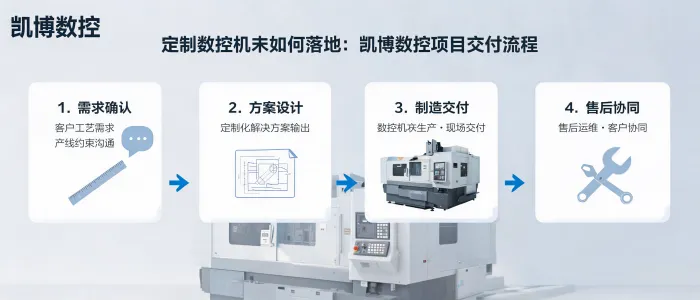
 custom CNC machine tools
project delivery
requirement confirmation
solution design
Ningbo Kaibo CNC Machinery Co., Ltd.
custom CNC machine tools
project delivery
requirement confirmation
solution design
Ningbo Kaibo CNC Machinery Co., Ltd.
 55
|
5-axis CNC shoe last milling machine
DC6060A CNC milling machine
shoe mold processing equipment
Kaibo CNC milling machine
high-efficiency shoe mold manufacturing
55
|
5-axis CNC shoe last milling machine
DC6060A CNC milling machine
shoe mold processing equipment
Kaibo CNC milling machine
high-efficiency shoe mold manufacturing
 438
|
CNC engraving and milling machine
procurement checklist
supplier evaluation
after-sales service
Ningbo Kaibo CNC Machinery Co., Ltd.
438
|
CNC engraving and milling machine
procurement checklist
supplier evaluation
after-sales service
Ningbo Kaibo CNC Machinery Co., Ltd.
 348
|
5-axis shoe last CNC milling machine
DC6070 CNC machine
shoe mold manufacturing equipment
CNC milling machine performance advantages
shoe mold processing efficiency improvement
283
|
CNC engraving and milling machine
concept explanation
mold processing
precision manufacturing
Ningbo Kaibo CNC Machinery Co., Ltd.
348
|
5-axis shoe last CNC milling machine
DC6070 CNC machine
shoe mold manufacturing equipment
CNC milling machine performance advantages
shoe mold processing efficiency improvement
283
|
CNC engraving and milling machine
concept explanation
mold processing
precision manufacturing
Ningbo Kaibo CNC Machinery Co., Ltd.