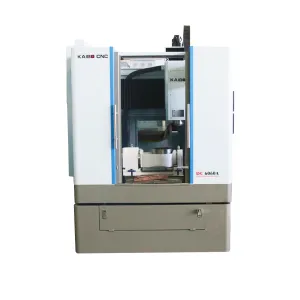
The shoe mold manufacturing sector consistently grapples with the challenge of optimizing machining efficiency. With increasingly complex designs and rising market demands, manufacturers must seek solutions that not only enhance productivity but also guarantee precision and reliability. Enter the DC6060A: a state-of-the-art 5-axis shoe sole mold milling machine equipped with a precision-engineered rotary worktable and advanced CNC stability technologies. This article elucidates how the DC6060A transforms traditional processes by streamlining operations and boosting throughput, enabling shoe mold manufacturers to elevate their competitive edge.
Conventional shoe mold machining often involves multiple setups and repositioning, which can extend production lead times by up to 30%. Additionally, machining errors during manual repositioning can degrade mold quality, escalating rework costs by approximately 15%. In a competitive marketplace where speed and precision determine success, the ability to reduce machining cycles and enhance stability without compromising accuracy is paramount. The DC6060A directly addresses these pain points.
Central to the DC6060A's advantage is its meticulously engineered rotary worktable. Unlike traditional models employing only linear axes, the DC6060A’s rotary table enables continuous 360-degree rotation around the C axis, synchronized seamlessly with the machine's 5-axis movements. This design facilitates multi-faceted machining of complex shoe soles without manual repositioning.
The rotary table's precision is ensured by high-resolution encoders and a robust servo system, providing repeatability within ±0.003 mm. As a result, manufacturers can perform intricate cuts and undercuts in a single setup, reducing process complexity and enhancing dimensional consistency.
Real-world trials from leading shoe mold manufacturers reveal that integrating the DC6060A decreased total machining time by an average of 25%. Furthermore, the number of setups per mold dropped from three or four to just one, eliminating intermediate manual adjustments and thereby lowering the possibility of human error.
| Metric | Traditional Milling | DC6060A Milling | Improvement |
|---|---|---|---|
| Average Machining Time (hours) | 8.0 | 6.0 | -25% |
| Number of Setups | 3 to 4 | 1 | -70% |
| Rework Rate (%) | 15 | 5 | -66% |
Beyond mechanical innovation, the DC6060A features an advanced CNC control system offering unparalleled stability. This system employs adaptive feed rate compensation and vibration damping algorithms which maintain cutting precision even under complex load conditions. Consequently, mold surface finishes exhibit improved uniformity, meeting tolerances within ±0.01 mm consistently — a critical factor in the shoe mold industry where surface quality directly affects sole durability and comfort.
A well-established shoe mold producer in southern China recently incorporated the DC6060A into its production line. Within six months, the company reported a 20% increase in monthly output alongside a 15% reduction in labor costs due to minimized manual interventions. Additionally, improved mold accuracy led to an uptick in client satisfaction and repeat orders, underscoring how technological upgrades translate into tangible business value.
This case exemplifies how adopting specialized milling solutions like the DC6060A aligns with industry demands for agility, precision, and cost-effectiveness.
The DC6060A 5-axis milling machine’s rotary worktable and CNC enhancements represent a leap forward in shoe mold manufacturing technology. By significantly reducing machining time, setup complexity, and rework rates, it carves a pathway for manufacturers to stay competitive amid growing market challenges.
What specific efficiency hurdles does your production currently face? How might integrating a rotary worktable CNC machine transform your workflow and output quality? Explore the potential of the DC6060A and see firsthand how cutting-edge automation and precision engineering can redefine your manufacturing standards.

 355
|
355
|
 BT40 spindle wheel CNC milling machine DC1090A
market competitiveness
customer case studies
comparison with traditional vertical machining centers
product engraving
mold processing
BT40 spindle wheel CNC milling machine DC1090A
market competitiveness
customer case studies
comparison with traditional vertical machining centers
product engraving
mold processing
 168
|
High speed heavy cutting
Vertical Machining Center
Mitsubishi E80 control system
Efficient milling
168
|
High speed heavy cutting
Vertical Machining Center
Mitsubishi E80 control system
Efficient milling
 415
|
FANUC GV2030
Heavy Duty Machining Center
High precision milling machine
415
|
FANUC GV2030
Heavy Duty Machining Center
High precision milling machine
 104
|
CNC milling machine
car parts
Efficient processing
104
|
CNC milling machine
car parts
Efficient processing
 488
|
Plastic mold manufacturing
CNC milling machine
DC1317
Large mold
High precision milling
488
|
Plastic mold manufacturing
CNC milling machine
DC1317
Large mold
High precision milling